
Professional Life & Expertise
I am An Economist
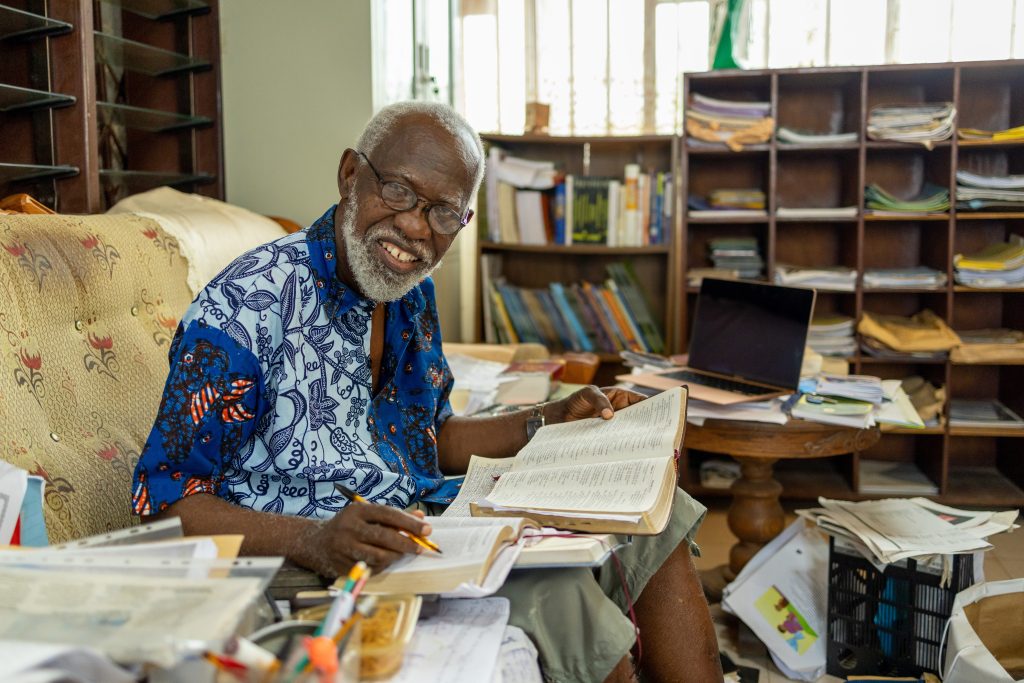
Basically, I am an Economist. Except that, I think I have grown Economics. For example at the National Policy Fair 2010, I was invited me to speak on “Ghana’s Part II Industrialization.” Some people would say this man, he is everywhere, is he an Economist? Am regarded as one of the top 100 Economists who have been produced by the University of Ghana and three years ago I was awarded with a gold medal. I think that Economics at a certain time you have to leave it for the younger ones. I understand economics in a way that many people don’t understand because my Economics is not a book Economics. It is one of the first principles.


Professor of Leadership.
The second area which is actually came in later but people would want to hear more so that one count much now because I came into that is Leadership. So my professorship is two things; Professor of Economics and Professor of Leadership.
Educationist
Then what many people in Ghana have come to associate me with; Education. I am an Educationist but Educationist from grass root. I am a “Cert A” teacher before GIMPA. But I have taught at the University of Ghana, Sydney and other places before coming to GIMPA. But I am an Educationist/Education Administrator because they are not the same field. It is a tripartite qualification. It is teaching, education generally and education administration.
Public Administrator
Then I was forced into Public Administration. So in fact, most of my published articles are in Public Administration.
Chartered Marketer
The other cluster is marketing. I am the oldest Chartered Marketer in Ghana. I chartered in 1973 but this does not mean am the oldest marketer but one who is qualified to the big role of chartered list to guide those who want to have the chartered degree and charter professionally.
Chartered Company Secretary
I am a Chartered Company Secretary (CIS). CIS is a qualification during our time which has now become MBA because of MBA, it has almost vanished. The Americans had the MBA and the British Chartered Company Secretary.
Ghana Investment Promotion Centre
Professor Adei started work at CIB on October 3, 1973, as an Evaluation Officer. And, with his boss being the de facto Minister of Finance under the Acheampong government in the 1970s and still Executive Chairman of CIB, Dr Donkor Fordjour called the freshly-minted economist one day and threw a challenge to him—find a solution to Ghana’s foreign exchange control problem.
At the time, there was a foreign exchange shortage; a shortage of goods; and the military government tried to ration by fiat, using a system that was abused and became steeped in corruption. The shortage in foreign exchange resulted in the inability of the Central
Bank to allow the repatriation of profits of foreign companies. Provoked to think creatively, he came up with a proposal.
“I proposed that if the foreign companies would invest in the agricultural sector in Ghana, for every dollar of investment they make with their unrepatriated dividends, we will match it with a dollar for dollar with foreign exchange to repatriate immediately. In so doing, their monies will not just lie idle, but part would be utilised productively.”
“He bought into it, got cabinet approval and we started implementing it. The effect was so great. The foreign companies invested massively in the agriculture sector especially, in oil palm plantations. The only condition was that they had to service out-growers. This made Ghana self-sufficient in oil palm at the time,” he recalls.
The Board took notice of this and his stellar performance with other tasks and with his immediate boss moving into politics, the young economist rose to become the Deputy Director and Head of Research. During his time at the CIB, he proceeded to obtain a PhD in International Economics at the University of Sydney, Australia.

High Quality Promise
Ut elit tellus, luctus nec ullamcorper mattis, pulvinar dapibus leo. Lorem ipsum dolor sit amet, consectetur adipiscing elit. Ut elit tellus, luctus nec ullamcorper mattis, pulvinar dapibus leo.
Favorite quote
The more you read, the more things you shall know. The more that you learn, the more places you shall go.
A betrayal that paved way for a glorious diplomatic career
Stephen Adei enjoyed working at CIB, that is until a fateful incident on October 15, 1985, during the Provisional National Defence Council (PNDC) era.The National Investment Bank (NIB) held a get-together for the senior staff and Prof. Adei was invited to brief the Bank about the newly introduced investment code.
Present was a lady journalist from the national newspaper – Daily Graphic. She asked him whether the practice at that time, where institutions of state were all headed by people in acting capacities, was not going to affect investment promotion in the country. He responded that it was detrimental to the confidence investors had in the economy, “so it would have been better for the government to confirm all appointments or look for substantive ones.”
The following day, it was the headline story in the Daily Graphic; his bosses became hysterical. The next morning, unknown to him, they held a press conference dissociating themselves from his comments. “I did not even know they had conducted a press conference disassociating themselves from me. I went to work that day, worked, and fraternised with them. It was not until the evening TV news that I heard… the acting Chief Executive and the directors have disassociated themselves from the statement of Stephen Adei,” he recounts.
The following day, he got a letter from Mr. P.V. Obeng, who was at the time, the de facto Prime Minister, asking him to explain why he was “engaging in an act that was detrimental to the economy of Ghana.”
The allegation was tantamount to treason. There was silence on the issue thereafter. It was only one Ofori Atta, the then editor of the Spectator newspaper who wrote that what Adei had said was the right thing.
Professor Adei wrote a four-page response to Mr. P.V. Obeng, in effect stating that if they were looking for the real enemy of the state “I am not one of them.” He explained that he was simply doing his job as a public servant.
There was no response for two weeks. “Those were the most anxious two weeks of my life,” he admits.
I later found out the letter was read at a full PNDC meeting and that showed how serious they took it. From the meeting, I was later told that Jerry John Rawlings, the chairman of the PNDC stood up and said: “but this boy was doing nothing wrong.” That was the end of the matter. Chairman Rawlings saved him. Prof. Adei subsequently resigned from CIB following the incident. He could not see how he could work any longer with a team led by Mr. Apotsi, the then Acting Chairman who would lead a team to do such a press conference.
The Commonwealth Secretariat
Months prior, he had seen an advert in ‘The Economist’ for the position of Senior Economist at the Commonwealth Secretariat whilst visiting a friend at the Challenge bookshop. He applied, passed the interview and got the job—but he did not reply to the offer letter sent him, ostensibly rejecting the job. However, after the incident, he got in touch with the Secretariat again inquiring about the availability of the role. That was about three months after they had given him the offer. It was available and he served in that capacity between 1986 and 1989.
UNDP, South Africa, and the Covenant
In 1989, he joined the United Nations Development Programme (UNDP) headquarters in New York as a Senior Economist and later rose to become the Chief of the Directorate of Africa Bureau. Shortly after joining the UN organisation, Prof. Adei’s boss, the Director of the Bureau at the UNDP, Pierre Claver-Dambah, unexpectedly resigned.
He was replaced by Ellen Johnson Sirleaf – who would later become President of Liberia – as the new Head of the Africa Bureau. She assumed her new appointment just at the time he was being considered as UN Ambassador to Uganda. “I do not know what others told her, but she made a passionate request that I work with her for one more year before going to the field. This was to enable her to transit into her new role,” he recalls. Johnson-Sirleaf was of the impression that a totally new person in his role would not be as helpful as he would. He obliged and ended up working with her for another three years instead of one year.
In 1994, South Africa became independent. A British national by the name of David Whaley was appointed to be the UN Ambassador, (Coordinator and Resident Representative) there. But he was then in Kenya and could not go immediately. A Senegalese friend of Prof. Adei was then sent there ahead of the arrival of Whaley. Due to some events, however, the UN decided to withdraw the Senegalese.
Prof. Adei was given three days’ notice to step in. One morning in August of 1994, Mrs. Johnson-Sirleaf entered his office and dropped the bombshell. She said, “Stephen, you have to go to South Africa.” He had never worked in the field let alone as Head of the UN system in a country. He was unprepared mentally for this onerous task.
And, beyond that, he made a covenant with his wife and family—that he would never leave them for more than three consecutive months unless he was in prison, which would not be his choice. “So, I raised that to make my argument stronger since I knew South Africa then was not a family duty station. But, bent on ensuring that I take it up, she told me the UN will finance my trips back to New York to see my family every six weeks. Eventually, I had to oblige.” He will forever be remembered as the man who set up the first UN office in post-Apartheid South Africa.
When he returned to New York from South Africa, he had to prepare to move again to Namibia. Between February and August 1995, he rounded off his job as the Chief in the Directorate of the Regional Bureau for Africa and obtained his credentials as the UN Coordinator and the Resident Representative of UNDP and Head of the UN delegation in Namibia.
‘Your Excellency, you must be mad, I must be mad, or a third person is mad.’
After four and half years in Namibia, Prof. Adei was to be reassigned to another country but decided he had had enough diplomatic work. He resigned at the age of 51 taking advantage of a package and headed to Ghana to begin a revolution at the Ghana Institute of Management and Public Administration (GIMPA) as its Rector.
The current Minister of Trade and Industry, Alan John Kyerematen, who then was employed under the UNDP regional program had visited Namibia in 1998. Naturally, as the UNDP Rep, Prof. Adei was his host. When he was leaving, Prof. Adei causally told him he would be resigning and returning to Ghana.
Upon return to Ghana, Kyerematen saw an advert in the dailies for people interested in becoming Director-General of GIMPA to apply. He called Prof. to check it out.
“As a Ghanaian would treat a friend, I jokingly told him I am not on the market for a job. Coincidentally, a mutual friend, the late Akwasi Aforo, was sitting in front of my desk, he asked who was on the line. I told him Alan was trying to sell me a GIMPA job. He took the phone from me and after talking to Alan, I heard him say ‘leave it to me’. To cut a long story short Akwasi Aforo persuaded me to write an application before the deadline while I was not thinking about it. Actually, he wrote it for me, took my unedited CV, put it in an envelope and brought it to Ghana,” Professor Adei notes.
In two weeks, he got a response and was invited for an interview. There were other candidates for the job, all professors—one was the Dean of Social Science at the University of Ghana, the other the ‘heir apparent’ at GIMPA who acted as CEO for four months before Prof. Adei took over and a Ghanaian professor resident in Washington.
The interview result, which he read on assuming duty said he was “head and shoulder above all the other candidates.” No wonder, within a month he was offered the job at the end of March 1999. He wrote back to tell them he was unavailable till December 1999, to which they retorted: “That is ok, we will wait for you.”
Then, one day, he was informed that the then Vice President, Prof J.E.A Mills, who became the President of Ghana (2009-2012) would like to see him anytime he was in Ghana. He, therefore, decided to call on him when he was passing through to New York in July 1998.
After the usual courtesies, with a serious look, the Vice President told him reports had reached the Head of State, Flt J.J. Rawlings that he was demonstrating against Rawlings’ government at UN headquarters. Rattled by the accusation, Professor Adei assumed what he describes as an “undiplomatic posture” and said: “Mr Vice President, you must be mad or I am mad or a third party is mad, who is mad?” This was because, in his capacity as a senior diplomat, how could he jeopardize the country’s global position and worse still as a UN Diplomat demonstrate against his own President. That is when my respect for H.E Attah Mills soared. He burst into laughter and added ‘that is the type of people you will be working with at GIMPA. They have told the President that and I have been asked to withdraw your appointment, but I told him I would not. Please don’t disappoint me. I thanked him and promised him I won’t and gave him a set of my books as a gift. May his soul rest in perfect peace.
GIMPA 101
Prof. Adei began his tenure at GIMPA on January 1, 2000. At the time, the institution was in dire financial straits. “GIMPA was so broke that just before I took over, I was told they had to draw on their last reserves to pay salary. Their poor financial performance was reflected in the salary of staff. As the Director General, my salary was US$345 equivalent! (My net salary at the UNDP was about US$10,000 a month). With such low salaries of lower staff, it was difficult to get the needed improvement,” he recounts.
However, through dexterity, Prof. Adei was able to turn the fortunes of the school around by trimming wastage, on the one hand, and with innovation, on the other.
Under his leadership, GIMPA was able to raise the rates of enrolments exponentially by introducing world class programmes in Economics, Hospitality, Business Administration, Marketing, Accounting and Finance, Banking, Computer Science as well as Transport and Logistics, among others at the undergraduate level and master’s degrees in public administration business and finance. It was an instant success.
The Institute also introduced a more flexible academic calendar, a first-of-its-kind 15-month diploma-to-bachelors ‘top up’ programmes. The salaries of staff, which had been stagnant in prior years, were raised as the school’s balance sheet improved. Since the end of 2001, the Institute has been the gold-standard for self-financing tertiary institutions, with turnover rising from less than US$500,000 to around US$15 million. Prof. Stephen Adei bowed out from GIMPA in December 2008, when he attained age sixty after nine years of selfless service.